
Compró la pequeña botella. Huele muy bien en la tienda. Pero dos semanas después está guardada en un cajón, medio llena y sin hacer nada por su sueño. ¿Le resulta familiar?
La mayoría de las personas utiliza la bruma para almohadas como si fuera ambientador — una pulverización rápida y listo. Precisamente por eso no ofrece todo su potencial. Utilizado correctamente, un buen spray para dormir se convierte en una pequeña señal nocturna para que su cerebro entienda que el día ha terminado. Utilizado sin cuidado, no es más que perfume para la funda de la almohada.
Así es como realmente puede aprovechar su compra.
Qué es realmente el spray para almohadas (y qué no es)
Antes de rociarlo todo en el dormitorio, conviene saber qué tiene entre las manos.
Spray para almohadas frente a ambientador y perfume
Estos tres productos suelen confundirse, pero están diseñados para funciones diferentes. El ambientador está concebido para disimular los malos olores de una habitación — es intenso, actúa rápido y desaparece pronto. El perfume está creado para asentarse sobre la piel cálida y evolucionar durante horas.
Una bruma para almohadas centrada en el descanso es algo más sutil. La concentración de la fragancia es menor, los ingredientes botánicos se eligen por su reputación relajante y no por su duración, y la fórmula está diseñada para adherirse suavemente al tejido sin empaparlo ni dejar residuos grasos.
Esa diferencia de propósito es precisamente lo importante. No se trata de dominar el ambiente de una habitación. Se trata de orientar suavemente el sistema nervioso hacia el "relajarse".
Los ingredientes que hacen el trabajo más importante
Dé la vuelta a la botella y normalmente encontrará un conjunto de ingredientes conocidos. La lavanda es la protagonista — por eso el spray de lavanda para almohadas destinado a la relajación se ha convertido casi en sinónimo de toda la categoría.
La manzanilla suele desempeñar un papel complementario, suave y ligeramente dulce. La bergamota aporta un toque cítrico que evita que la lavanda resulte pesada o medicinal. Algunas mezclas incorporan vetiver o sándalo para añadir una nota de fondo terrosa y reconfortante.
Ninguno de estos ingredientes es mágico. Sin embargo, son los botánicos más vinculados de forma constante con la relajación en los círculos de la aromaterapia, por lo que siguen apareciendo juntos.
Cómo usar el spray para almohada, paso a paso
Esta es la parte que estabas esperando. Es lo bastante sencillo como para hacerlo medio dormido, que es exactamente cuando lo necesitarás.
Paso 1: Agítalo primero (sí, siempre)
Los aceites esenciales y el agua no se llevan bien. Si se dejan reposar, los aceites aromáticos suben a la superficie mientras el agua se queda abajo. Si pulverizas sin agitar, algunas noches obtendrás una bruma débil y acuosa, y otras, una ráfaga que hará llorar los ojos.
Agitar durante cinco segundos redistribuye todo de manera uniforme. Es el paso menos glamuroso y el que más suele omitirse.
Paso 2: Sostén el frasco a la distancia adecuada
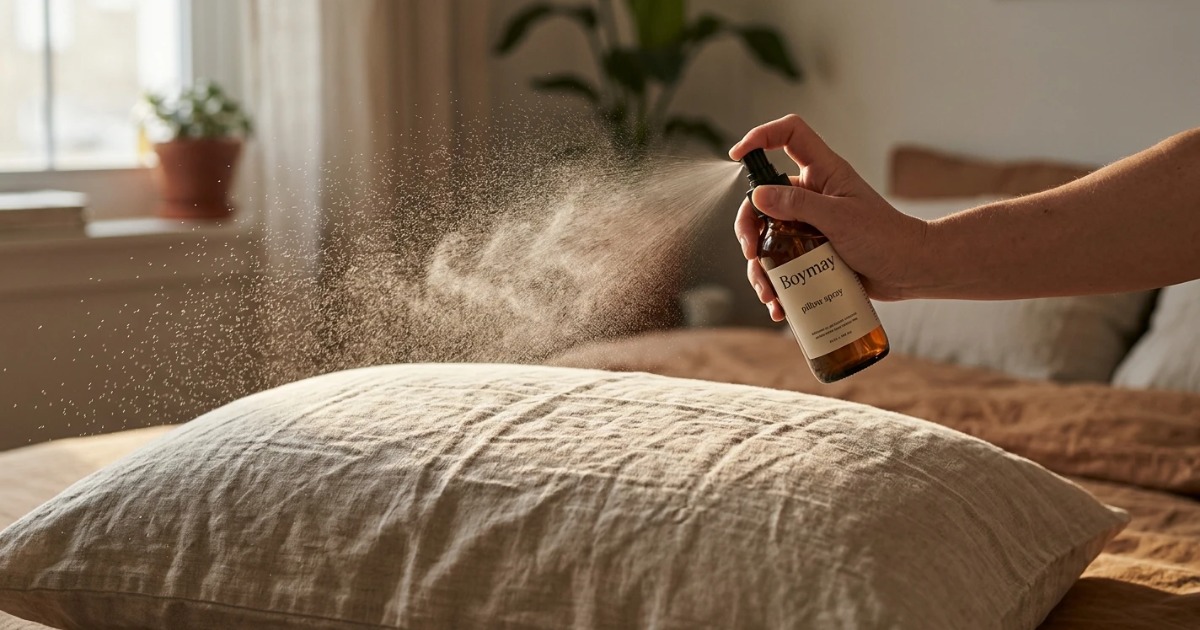
Apunta a una distancia aproximada de 20 a 30 centimetres de la tela — aproximadamente la longitud de tu antebrazo. Si pulverizas desde más cerca, no estarás creando una bruma, sino pintando. Se formarán zonas húmedas, el aroma se concentrará en un solo punto y el resto de la almohada no recibirá nada.
A mayor distancia, las gotas tendrán espacio para dispersarse en un velo fino y uniforme. Eso es lo que buscas.
Paso 3: Cómo aplicar correctamente el spray para almohada sobre la ropa de cama
Saber cómo aplicar el spray para almohada sobre la ropa de cama consiste, en gran medida, en no excederse. Dos o tres pulverizaciones ligeras sobre la funda de almohada son suficientes. Si quieres, añade una más a lo largo del borde superior de la sábana o del edredón — esa es la zona más cercana a tu rostro una vez que te acomodas.
Resista la tentación de cubrir toda la cama. El aroma se propaga. Una ligera pulverización sobre la almohada perfumará perfectamente el espacio alrededor de su cabeza y evitará que duerma sobre una zona húmeda.
Paso 4: Déjelo secar durante un minuto
Rocíelo antes de acostarse, no después de estar ya tumbado. Espere unos sesenta segundos para que se asiente y se seque. Esto hace dos cosas: evita que apoye la mejilla sobre una zona húmeda y permite que las notas de salida se suavicen hasta convertirse en un aroma más envolvente y adecuado para dormir.
Cuándo rociar el spray para almohada antes de acostarse
El momento es el aspecto en el que la mayoría de las personas se equivoca sin darse cuenta, y es más importante que la cantidad que utilice.
El intervalo de 10–15 minutos
Determinar cuándo rociar el spray para almohada antes de acostarse consiste en hacer coincidir el punto máximo del aroma con el suyo. Rocíe la almohada entre diez y quince minutos antes de acostarse. Para cuando su cabeza entre en contacto con la tela, las notas más intensas se habrán suavizado y el aroma ofrecerá su efecto más completo y equilibrado.
Si lo rocía con varias horas de antelación, gran parte del aroma ya se habrá desvanecido. Si lo rocía justo cuando se está metiendo bajo las sábanas, recibirá una primera impresión demasiado intensa que se disipará rápidamente — a menudo antes incluso de que se haya dormido.
Incorporarlo a una rutina de relajación
Aquí es donde el spray para almohada demuestra su utilidad. El aroma está estrechamente ligado a la memoria y a los hábitos. Si lo rocía en el mismo momento todas las noches — justo después de atenuar las luces, dejar el teléfono, quizá leer una o dos páginas — el olor deja de ser simplemente un olor y comienza a funcionar como una señal.
Su cerebro aprende la secuencia. Después de un par de semanas, esa nota de lavanda se convierte en un pequeño estímulo que indica "hemos terminado por hoy". La constancia tiene un efecto mayor que la fragancia en sí.
¿Cuánto es demasiado?
Más spray no significa dormir más. Por lo general, significa lo contrario.
El principio de "menos es más"
La nariz se adapta rápidamente. Empapa la almohada y, en cuestión de minutos, el cerebro deja de percibir por completo el aroma — una peculiaridad llamada fatiga olfativa. Así, has usado la mitad del frasco y no obtienes ninguno de los efectos calmantes que buscabas.
Peor aún, una aplicación excesiva puede convertir una mezcla relajante en una mezcla empalagosa. Algunas personas se despiertan con un dolor de cabeza sordo o una sensación de congestión, no por los ingredientes, sino por la cantidad aplicada. Aplicar una cantidad moderada mantiene agradable la experiencia y preserva el efecto.
Ajustes para personas con sueño sensible, niños y mascotas
No todos los hogares pueden tolerar un spray calmante para dormir de concentración completa en almohadas y ropa de cama. En la habitación de un niño, reduce la cantidad aproximadamente a la mitad o pulveriza la sábana en lugar de la almohada para que quede un poco más lejos de su rostro.
Los hogares con mascotas requieren un cuidado adicional — los gatos, en particular, son sensibles a ciertos aceites esenciales, por lo que debes pulverizar lejos de las zonas donde duermen y evitar las superficies que lamen. Si alguien en casa tiene un sistema respiratorio reactivo, pulveriza ligeramente los tejidos de la habitación y evita por completo la almohada más cercana a su respiración.
¿El spray para almohadas realmente ayuda a dormir?
Es una pregunta válida — y merece una respuesta honesta en lugar de adornos de marketing.
Lo que dice la investigación sobre los aromas y el sueño
Existe un conjunto auténtico de investigaciones sobre la lavanda y la relajación. Varios estudios pequeños han descubierto que inhalar lavanda antes de acostarse puede mejorar modestamente la sensación de descanso y la rapidez con la que las personas se duermen, probablemente al llevar al cuerpo hacia un estado más calmado y de menor activación.
La salvedad honesta, a fecha de 2026: gran parte de esta investigación incluye muestras pequeñas y períodos de estudio breves, y los resultados varían. La aromaterapia no sustituye el tratamiento de los trastornos reales del sueño. Considérala una ayuda suave para la inquietud habitual, no una cura para el insomnio.
Por qué funciona para algunas personas y no para otras
Dos factores explican la mayor parte de la variación. El primero es la rutina — las personas que lo usan de forma constante como parte de un ritual tienden a obtener mayores beneficios, en parte porque el propio ritual resulta tranquilizador.
El segundo es una simple cuestión de preferencias personales. Si no le gusta el aroma de la lavanda, ningún estudio hará que le resulte relajante. El olfato es profundamente subjetivo, y una fragancia que calma a una persona puede irritar a otra. Elija una mezcla con un aroma que realmente disfrute y sus probabilidades mejorarán considerablemente.
Cómo elegir la mejor bruma para almohada para dormir mejor
No todos los frascos son iguales, y la etiqueta le dice más que el envase.
Qué buscar en la etiqueta
La mejor bruma para almohada para dormir mejor suele compartir algunas características. Busque fuentes botánicas o de aceites esenciales identificadas por su nombre, en lugar de una vaga "fragancia." Evite las fórmulas con un alto contenido de alcoholes secantes agresivos, que pueden dejar la tela rígida y el aroma apagado.
El etiquetado que indique que es segura para la piel y los tejidos es importante, ya que su rostro estará en contacto con ella durante toda la noche. Y las credenciales de fabricación son un indicador real de calidad — por ejemplo, una producción certificada conforme a las normas GMP apunta a una formulación constante y a estándares de procesamiento más limpios, el tipo de supervisión sobre el que fabricantes por contrato consolidados como Boymay han construido su reputación.
Seguridad para los tejidos: ¿dejará manchas?
Un detalle que muchos competidores pasan por alto: pruebe el producto antes de confiar en él. Los tejidos delicados — seda, satén, lino fino — pueden reaccionar a los aceites y colorantes de formas que el algodón no lo hará.
Primero, haga una prueba en una esquina oculta. Rocíe una pequeña zona fuera de la vista, déjela secar por completo y compruebe si hay decoloración o marcas de agua antes de acercarse a sus buenas fundas de almohada. Treinta segundos ahora pueden evitar una sábana arruinada más adelante.
Errores comunes que debe evitar
Unos pocos ajustes rápidos que solucionan al instante la mayoría de los problemas de las personas.
Rociarlo directamente sobre la piel o el rostro
El spray para almohadas está formulado para tejidos, no para la piel. No es un perfume y no se ha probado para permanecer en el rostro durante ocho horas. Rociarlo directamente puede irritar la piel sensible o los ojos. Manténgalo sobre la almohada y deje que el aroma le llegue a través del aire.
Guardarlo bajo la luz solar o cerca del calor
La luz y el calor son enemigos de los productos botánicos. Un frasco dejado en un alféizar soleado o cerca de un radiador perderá su aroma y se deteriorará más rápido que uno guardado en un lugar fresco y oscuro. Un cajón de la mesita de noche es ideal — oscuro, estable y al alcance de la mano.
Preguntas frecuentes
P: ¿Puedo rociar spray para almohadas sobre la misma almohada todas las noches?
R: Por supuesto. De hecho, usar la misma almohada cada noche ayuda a crear el hábito asociado con el sueño. Solo debe mantener una cantidad ligera y constante — dos o tres pulverizaciones — en lugar de aumentar gradualmente la dosis. Incrementarla no intensifica el efecto; principalmente desperdicia producto y puede provocar fatiga olfativa.
P: ¿Cuánto dura el aroma?
R: Siendo realistas, espere un aroma perceptible durante unas horas después de rociarlo, que se desvanece suavemente mientras duerme. El tipo de tejido desempeña un papel importante — las fibras naturales, como el algodón, conservan el aroma durante más tiempo que los materiales sintéticos. Una habitación bien ventilada o con corrientes de aire lo dispersará más rápido, por lo que una habitación ligeramente más cálida y cerrada mantiene la fragancia durante más tiempo.
P: ¿Es seguro el spray para almohadas si tengo alergias o asma?
R: Proceda con precaución. Haga primero una prueba en una pequeña zona de la piel y considere rociar el tejido desde el otro lado de la habitación en lugar de hacerlo sobre la almohada situada justo debajo de la nariz. Existen sprays para dormir sin fragancia o hipoalergénicos precisamente por este motivo. Si padece asma importante o sensibilidad a las fragancias, conviene consultar brevemente con su médico antes de convertirlo en un hábito nocturno.
P: ¿El spray para almohadas manchará mis sábanas?
R: Un spray correctamente formulado no debería hacerlo. Las manchas suelen aparecer cuando el spray contiene demasiado aceite, se aplica en exceso o se pulveriza demasiado cerca, haciendo que las gotas se acumulen. Evítelo sosteniendo el frasco a la distancia de un brazo, aplicándolo suavemente y probándolo primero en una zona pequeña de los tejidos delicados. Un producto de calidad diseñado para la ropa de cama está formulado para evaporarse limpiamente y no dejar marcas.