
I've watched a single unverified sample turn into a 100,000-tablet headache. The tablets looked perfect on the client's desk, but the first pallet arrived with chipped edges, and half of them fizzed too slowly to satisfy the end user. That order got remade. Nobody wanted to pay for it twice.
This guide is the checklist my team uses on our own production floor. Follow it and you'll approve a sample you can actually trust — one where the first bulk run behaves like the tablet you signed off on, not a lucky prototype that never repeats.
What "Passing" Actually Means
A sample doesn't pass because it looks right. It passes when it performs consistently across five dimensions: dissolution, physical hardness, cleaning efficacy, appearance and fragrance, and packaging stability over time.
Miss any one of these and the failure usually shows up later — in a warehouse, a freight container, or a customer's kitchen sink. That's the expensive place to find out.
Cleaning Tablet Sample Testing at a Glance
If you only have 30 seconds before the deep dive: request performance data, not a photo. Ask the factory to test the same batch multiple times under the exact conditions your product will face, and document target numbers before anyone judges the result.
The 6 Tests Every Buyer Should Request
- Dissolution rate and time
- Hardness and friability
- Active ingredient efficacy
- Appearance and color stability
- Fragrance retention
- Packaging and shelf-life simulation
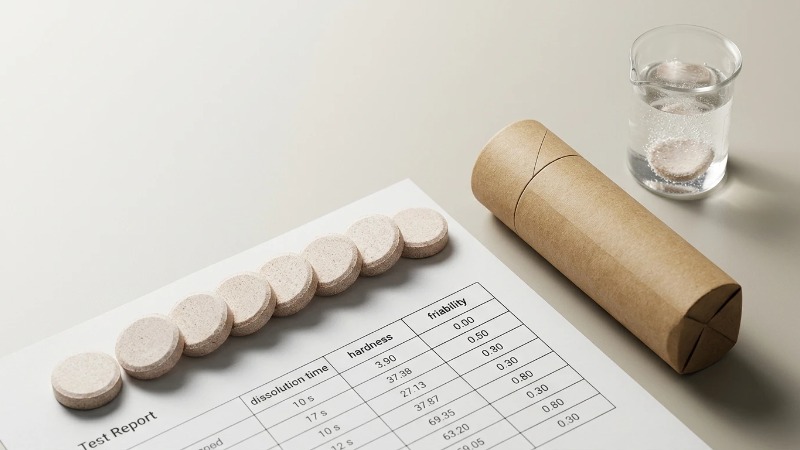
Foundational Concepts: Know What You're Testing
Buyers and QA teams often use loose language, and that's where miscommunication starts. Let's line up the vocabulary so you and the factory mean the same thing.
Effervescent vs. Dissolvable vs. Compressed Tablets
Effervescent tablets rely on an acid-base reaction — usually a citric acid and bicarbonate pairing — to release gas and break apart fast. Dissolvable tablets simply disperse in water without that fizz. Compressed tablets are denser and designed to erode slowly, common in toilet and tank applications.
The format dictates the test method. You cannot judge a slow-erode toilet tablet by the same stopwatch you'd use on a fizzing dishwasher tablet. That mismatch alone causes a lot of false rejections.
Key Terms: Dissolution Rate, Friability, and Active Load
Dissolution rate is how quickly a tablet fully breaks down under set conditions. Friability measures how much a tablet crumbles or sheds when handled — the enemy of clean freight. Active load is the concentration of functional ingredients doing the actual cleaning, as opposed to binders and fillers.
Step 1: Define Acceptance Criteria Before the Sample Arrives
We always push clients to set target numbers first. Otherwise sample approval becomes a gut feeling, and gut feelings don't survive a factory audit or a reorder dispute.
Building a Simple Spec Sheet
Write down what "good" means before you evaluate anything: target dissolution time, the water temperature you'll test in, tablet weight, an acceptable hardness range, and the scent profile. A one-page spec turns a subjective chat into a measurable pass or fail.
Example Acceptance Criteria by Tablet Type
| Test | Toilet Tablet | Dishwasher Tablet | Laundry Tablet |
|---|---|---|---|
| Dissolution time | Slow, controlled erosion (target range) | Fast, full break-down within cycle (target range) | Moderate dispersion (target range) |
| Water temp tested | Cold / ambient | Hot cycle | Warm and cold |
| Friability limit | Max % weight loss | Max % weight loss | Max % weight loss |
Values are shown as ranges to fill against each client's brief. Real targets depend on your formula, dosing, and end-use — we set them together rather than borrowing someone else's numbers.
Step 2: Test Dissolution Rate the Right Way
This is where vague supplier claims fall apart. "It dissolves fast" means nothing without a defined water volume, temperature, and whether the water was moving.
Controlled-Condition Method
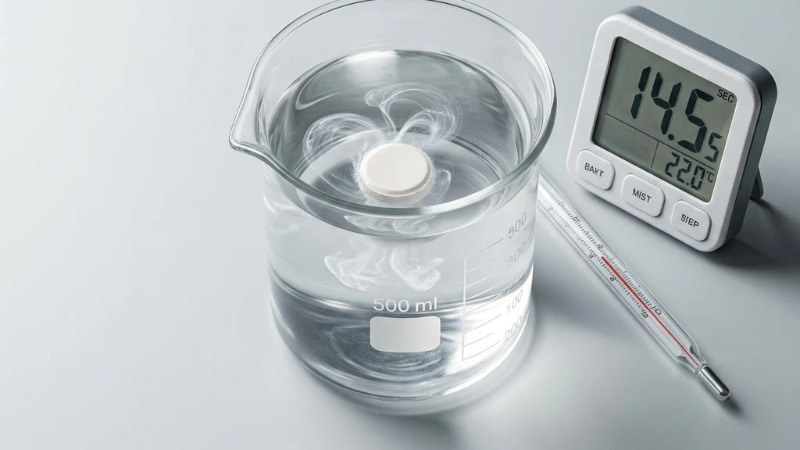
Use a fixed water volume — say a consistent 250 ml or 500 ml — at a measured temperature. Drop the tablet, start a timer, and record the moment it fully disperses. Run it once still and once with light agitation, because a moving dishwasher basket and a still toilet tank behave very differently.
Recording and Comparing Results
One tablet tells you almost nothing. Test at least five from the same batch and log every time. If your dissolution rate evaluation shows a wide spread — one tablet at 90 seconds, another at three minutes — you have a consistency problem, not a formula that's ready.
Step 3: Check Physical Integrity — Hardness, Friability, and Crumbling
Effervescent tablet quality control is really about surviving the journey. A tablet that cleans beautifully but arrives as powder has failed.
Simple Field Tests Without Lab Gear
- Drop test: release the tablet from roughly waist height onto a hard surface and inspect for cracks or shattering.
- Pressure test: press firmly between thumb and forefinger — it should resist, not powder.
- Edge inspection: run a fingernail along the rim, since chipped edges are where breakage begins.
Why Transit Damage Starts at the Sample Stage
In my experience, weak edges on a sample predict warehouse and freight breakage almost every time. Vibration over thousands of kilometers finds every soft corner. If the sample chips under a fingernail, the container will do far worse.
Step 4: Verify Cleaning Performance and Active Ingredients
A tablet has to clean, not just dissolve attractively. This step is easy to skip and expensive to ignore.
Real-World Use Testing
Match the test to the tablet's job. For a dishwasher tablet, run a load with dried-on residue and check the plates afterward. For a toilet tablet, watch stain lift, foam behavior, and odor control over a set number of flushes. Photograph before and after so the evidence is objective.
Fragrance, Color, and Residue After Dissolution
Look at the water once the tablet is gone. Is there film, sediment, or staining? Did the color hold or bleed? Does the fragrance still read the way it did on day one, or has it faded? These small signals separate a premium tablet from a cheap one.
Step 5: Simulate Shelf Life and Packaging Stability
Effervescent products are moisture-sensitive by nature. The reaction that makes them work is the same reaction humidity triggers prematurely.
Humidity, Heat, and Seal Testing
We stress the packaging on purpose. Hold samples in a high-humidity environment, expose others to elevated heat, and check the seal integrity after handling. If a tablet swells, softens, or starts fizzing inside its wrapper, the packaging spec needs work before bulk — not after.
Stability Test Conditions and What They Reveal
| Condition | Simulates | What to Watch For |
|---|---|---|
| High humidity | Coastal or warehouse storage | Softening, early fizzing |
| Elevated temperature | Container shipping | Discoloration, cracking |
| Seal stress | Long transit | Moisture ingress |
Common Mistakes Buyers Make During Sample Approval
Approving One Tablet Instead of a Batch
Single-tablet approval hides the exact thing you're paying to verify: consistency. A good sample from a bad batch is just luck.
Testing in the Wrong Water or Temperature
Judging a hot-cycle dishwasher tablet in cold tap water gives you a false failure. Match the test water to the real use case, every time.
Ignoring the Gap Between Sample and Mass Production
Line speed, mold count, and raw-material lots all shift results between a hand-made sample and a full run. This is the honest part most suppliers won't mention. A disciplined factory controls it by locking raw-material specifications, documenting press settings, and running a pre-production sample on the actual line — not on a bench.
From Approved Sample to Bulk Order: What Happens Next
The Pre-Production "Golden Sample" Sign-Off
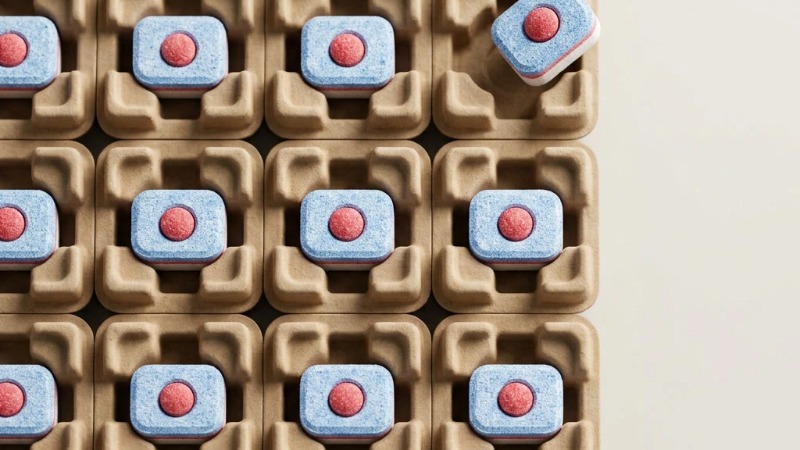
Once testing passes, both sides sign a reference sample — the golden sample. It becomes the physical contract. If bulk deviates from it, there's a documented standard to point to, which protects you and keeps us honest.
Realistic Sample and Bulk Order Manufacturing Lead Time
Set expectations early. Custom sample development typically runs 7–14 days depending on formula, fragrance, appearance, and packaging complexity. Bulk production usually follows in 25–30 days. Anyone promising both in a few days is skipping steps you'll pay for later.
Conclusion & Next Step
Disciplined sample testing is the cheapest insurance in manufacturing. Define your acceptance criteria, test dissolution properly, check physical integrity, verify real cleaning performance, and simulate shelf life — five steps that stop a six-figure mistake before it ships.
Work With a Factory That Tests Alongside You
Since 1995, Boymay (BOMAY) has focused on OEM/ODM manufacturing of bath and personal care products, working from a 40,000 m² facility with 16 automated production lines and a team of more than 200 people. We're GMP, ISO, FDA, and SMETA certified, with MOQ from 1,000 units and support for high customization.
If you want a supplier that runs this testing framework with you — from golden sample to reliable bulk supply — contact our team to request custom samples or discuss your project. We'll help you validate the sample so your first bulk run performs exactly like the one you approved.
Frequently Asked Questions
Q: How many samples should I test before bulk production?
A: Test several tablets from the same batch, not one. Five or more gives you a real read on consistency across dissolution, hardness, and appearance. A single tablet only tells you that one tablet worked.
Q: How long does dissolution testing take?
A: The test itself is quick — often under five minutes per tablet — but the value comes from repeating it under fixed water volume and temperature and comparing the spread across multiple tablets.
Q: What's a normal MOQ for custom cleaning tablets?
A: Our practical starting point is 1,000 units. That keeps custom tooling, formula, and packaging economically viable while still being accessible for brands testing a new line.
Q: Can formulas be customized — vegan, custom mold, custom fragrance?
A: Yes. Formulas can be developed vegan and without animal testing, and we support custom molds, fragrances, colors, and packaging. The right level of customization depends on your brief, which is exactly what the spec sheet in Step 1 captures.